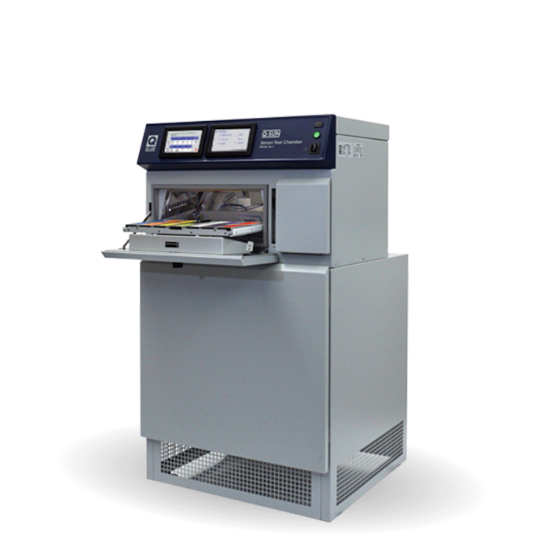
The Q-Lab Q-SUN Xe-1-BE Tabletop Xenon Arc Test Chamber (Basic) is an economical single-lamp xenon arc weathering tester for laboratories that need controlled full-spectrum light and temperature exposure in a compact benchtop format. The Xe-1-BE model uses a flat-array specimen tray, one 1800 W full-spectrum ozone-free xenon arc lamp and SOLAR EYE irradiance control to reproduce the damaging effects of sunlight on materials, coatings, plastics, textiles, packaging and finished products. It is suited to laboratories that need ASTM G155 and ISO 4892-2 style xenon arc exposure capability where the selected test cycle does not require spray, relative humidity control, back spray, chiller operation or water immersion. For technical buyers comparing Q-SUN configurations, the Xe-1-BE is the Basic Model E tabletop option, offering simple operation, compact installation and Q-Lab calibration support for light and temperature controlled exposure programmes.
Test Standards Supported
The Q-SUN Xe-1-BE is relevant to xenon arc weathering and lightfastness methods where the required exposure cycle can be run with irradiance and temperature control only. It is important to confirm the exact test cycle before purchase because this Basic configuration does not include water spray, relative humidity control, back spray, chiller operation or water immersion.
- ASTM G155, xenon arc exposure of non-metallic materials, where the selected cycle does not require unavailable features.
- ISO 4892-2, plastics exposed to laboratory xenon arc light sources, where the selected cycle suits the Basic Xe-1 configuration.
- ISO 16474-2, paints and varnishes exposed to laboratory xenon arc light sources, where water spray or RH control is not required by the chosen cycle.
- ASTM D2565, xenon arc exposure of plastics intended for outdoor applications, subject to cycle requirements.
- ASTM D6695, xenon arc exposure of paints and related coatings, subject to cycle requirements.
- AATCC TM16 and AATCC TM169, textile lightfastness methods, where the required cycle can be run without unavailable moisture functions.
- ISO 105-B02 and ISO 105-B04, textile colour fastness methods, subject to the required exposure cycle and filter configuration.
- ICH Q1B photostability workflows, where the laboratory method and required exposure conditions align with the Xe-1-BE configuration.
Configuration Notes
- This Xe-1-BE model is the Basic Xe-1 configuration and does not include water spray.
- This model does not include relative humidity control. RH control is available on Q-SUN Xe-2 and Xe-3 humidity configurations, not Xe-1-BE.
- This model does not include water immersion. Water immersion is specific to the Xe-1-WE configuration.
- This model does not include a chiller. Chiller configurations are separate Xe-1-BC or Xe-1-SC variants.
- Xe-1 controls either black panel / insulated black panel temperature or chamber air temperature, but not both simultaneously.
- Chamber air temperature control is optional on Xe-1-BE and should be confirmed if CAT control is required for the intended method.
Key Features
- Compact tabletop Xe-1 format for laboratories needing xenon arc weathering capability without a full-size floor-standing chamber.
- Single 1800 W full-spectrum ozone-free xenon arc lamp for realistic simulation of sunlight across ultraviolet, visible and infrared wavelengths.
- Flat-array specimen tray with 25 x 46 cm exposure area for standard panels and smaller three-dimensional specimens.
- SOLAR EYE irradiance control with 340 nm, 420 nm or TUV sensor options for repeatable light exposure conditions.
- Model E feature set with dual touchscreen displays and improved irradiance/lamp efficiency.
- AUTOCAL UC20 calibration compatibility for irradiance and black panel temperature calibration.
- Air-cooled xenon lamp design to simplify installation and reduce maintenance complexity compared with water-cooled lamp systems.
- Durable optical filter options for direct sunlight, window glass and extended UV simulation, selected according to the test method.
- Standard Ethernet datalogging for monitoring and documenting exposure conditions.
- Full-colour interface available in 17 languages for straightforward day-to-day operation by laboratory staff.
Performance Specifications
- Chamber type: tabletop flat-array xenon arc test chamber.
- Light source: 1 x 1800 W full-spectrum ozone-free xenon arc lamp.
- Specimen capacity: 17 specimens at 51 x 102 mm.
- Specimen area: 25 x 46 cm.
- Specimen orientation: 10° measured from horizontal.
- Maximum evenly distributed specimen weight: 14 kg.
- Black panel temperature range: 45 to 90 °C in light, 40 to 70 °C with IR filter and 25 to 50 °C in dark.
- Insulated black panel temperature range: 50 to 100 °C in light, 45 to 80 °C with IR filter and 25 to 50 °C in dark.
- Optional chamber air temperature range: 35 to 55 °C in light and 30 to 45 °C in dark.
- External dimensions: 78 x 52 x 65 cm.
- Weight: 50 kg.
- Electrical requirements: 208 V 1-phase at 12 A or 230 V 1-phase at 11 A, 50/60 Hz.
Specimen Capacity and Configuration
The Xe-1-BE specimen tray provides a 25 x 46 cm exposure area and supports 17 specimens at 51 x 102 mm. The flat-array format and 10° specimen orientation make the chamber practical for routine material screening, colour change assessment, lightfastness evaluation and smaller product or component exposure work. The Xe-1 and Xe-3 capacity values in the Q-Lab specification bulletin are shown without specimen holders, so fixture choice should be considered when planning the final usable loading arrangement.
Because the Xe-1-BE is a Basic model, it is best suited to test cycles centred on light exposure and temperature control rather than moisture-driven weathering. This distinction matters when selecting a chamber for standards that have multiple cycles or optional exposure conditions. If the laboratory needs water spray, a Xe-1-SE should be reviewed. If sub-ambient chiller operation is required, an Xe-1-BCE or Xe-1-SCE should be reviewed. If full relative humidity control is required, a Q-SUN Xe-2 or Xe-3 humidity model is the more appropriate family.
Operating Specifications
The Xe-1-BE has compact installation requirements compared with larger xenon arc weathering chambers. The external footprint is 78 x 52 x 65 cm, with a listed weight of 50 kg. The electrical requirement is 208 V 1-phase at 12 A or 230 V 1-phase at 11 A, with voltage tolerance of ±10% and 50/60 Hz operation. Q-Lab’s recommended laboratory ambient condition is 23 ± 5 °C and 50 ± 25% relative humidity, and the chamber should not be operated in laboratory ambient conditions above 36 °C or above 80% RH.
The Xe-1-BE does not require water for spray, humidification or immersion because those functions are not included in the Basic configuration. For temperature control, Q-Lab notes that Xe-1 models can control either black panel / insulated black panel temperature or chamber air temperature, but not both at the same time. Chamber air temperature control is optional on Xe-1-BE and should be confirmed at the quotation stage if the intended test method requires CAT control rather than black panel temperature control.
Why Choose the Q-Lab Q-SUN Xe-1-BE?
The Q-Lab Q-SUN Xe-1-BE is well suited to laboratories that need a compact, lower-complexity xenon arc tester for light and temperature based material screening. It provides the core benefits of Q-SUN technology, including full-spectrum xenon exposure, SOLAR EYE irradiance control, AUTOCAL calibration support, durable optical filters and simple touchscreen operation, without adding moisture or chiller systems that may not be required for the target application. This makes it a practical entry point for laboratories moving from outsourced weathering tests to in-house accelerated exposure capability.
For technical buyers, the main value is correct scope alignment. The Xe-1-BE is not the right choice for methods that require water spray, RH control, back spray, water immersion or simultaneous BP/CAT control. However, where the laboratory requires a compact xenon arc chamber for Basic light and temperature exposure cycles, it provides a focused and efficient configuration that supports repeatable, documented testing with Q-Lab calibration infrastructure. This is especially useful for quality teams comparing materials, validating formulation changes or screening supplier alternatives before committing to larger-scale testing.
John Morris Group supplies Q-Lab capital test equipment across Australia, New Zealand, Sri Lanka and the Pacific Islands, supporting customers with model selection, facility planning, calibration workflow, installation considerations and after-sales support. Contact John Morris Group for a quote on the Q-Lab Q-SUN Xe-1-BE Tabletop Xenon Arc Test Chamber (Basic), including confirmation of the correct filters, sensors, specimen holders and optional CAT control requirements for your test programme.