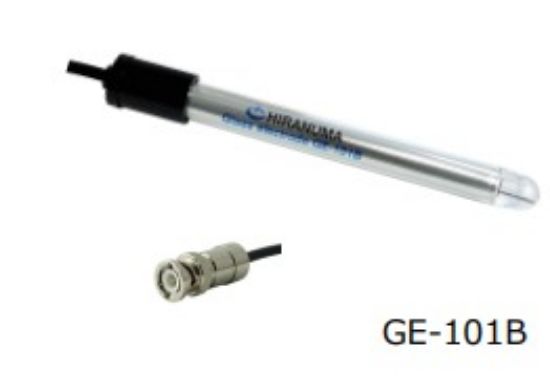
The Hitachi GE-101B Glass Electrode, 0.6 m Cable (HIRAN-D252350-1; manufacturer part D252350-1) is a general-purpose indicator electrode for acid and base neutralisation titration. It operates across a temperature range of -5 to 80 °C and is suitable for compatible Hitachi Hiranuma automatic titrators, including the COM-300A and COM-A19.
Key Features
- Designed for neutralisation titration, supporting potentiometric measurement of acids and bases
- General-purpose glass indicator electrode, suitable for routine automatic titration workflows
- Broad operating temperature range, suitable for samples from -5 to 80 °C
- Integrated 0.6 m connection cable, providing practical reach between the electrode holder and titrator
- Compact electrode body, measuring approximately 135 mm long with a 12 mm body diameter
- Recommended reference-electrode pairing, listed by Hiranuma for use with the RE-201Z during neutralisation titration
- Compatible with selected automatic titrators, including the COM-300A and COM-A19 models
- Dedicated titrator accessory, manufactured for Hiranuma automatic potentiometric titration systems
Note: Hiranuma lists the RE-201Z reference electrode as the corresponding reference electrode for general-purpose neutralisation titration. Confirm the complete electrode configuration required for the intended titrator and method.
Benefits
- Supports routine acid and base analysis using potentiometric endpoint detection.
- Accommodates a wide range of sample temperatures for flexible laboratory workflows.
- Simplifies replacement selection through clearly defined model and manufacturer part references.
- Integrates with compatible Hitachi Hiranuma titration systems without requiring an alternative electrode format.
Why Choose the Hitachi GE-101B Glass Electrode, 0.6 m Cable (HIRAN-D252350-1)?
The Hitachi GE-101B Glass Electrode, 0.6 m Cable (HIRAN-D252350-1) provides a general-purpose solution for acid and base neutralisation titration on compatible automatic titrators. John Morris Group can assist with confirming titrator compatibility and selecting the corresponding reference electrode for the intended method.