IANZ, International Accreditation New Zealand, is the government-recognised body that assesses whether a testing, calibration, inspection or certification organisation in New Zealand is technically competent to do the work it claims to do. If a laboratory or calibration service says it is "IANZ accredited," it means an independent assessor has audited its methods, equipment, staff competency and quality system against an international standard, usually ISO/IEC 17025 for testing and calibration laboratories.
For a lab manager choosing a calibration provider, or a technician trying to work out whether a certificate will hold up in an audit, "IANZ accredited" is meant to be a shortcut for "you can trust this result." This guide explains what that shortcut actually covers, how IANZ compares to accreditation bodies buyers might recognise from overseas, and what to check before accepting a calibration certificate as IANZ accredited.
In This Guide
What Is IANZ? · IANZ vs Other Accreditation Bodies · Why It Matters · What ISO/IEC 17025 Covers · Checking A Certificate · Common Mistakes · FAQ
What Is IANZ?
International Accreditation New Zealand is a business unit of Toitu te Waiora and operates as New Zealand's national accreditation body. It does not carry out testing or calibration itself. Instead, it assesses organisations that do, and grants accreditation to the ones that meet the relevant international standard.
Most laboratory calibration and testing accreditation in New Zealand is assessed against ISO/IEC 17025, the international standard for the competence of testing and calibration laboratories. An IANZ-accredited calibration certificate means the calibration was performed under a quality system that IANZ has independently checked, not just a claim the supplier makes about itself.
Quick Answer
IANZ accreditation means an independent NZ body has audited a lab's methods, equipment and staff against ISO/IEC 17025 and confirmed the results it produces are technically reliable. It is not a membership fee or a logo a supplier can simply choose to display. If a certificate carries the IANZ endorsement mark, it should also show the specific scope of accreditation, since a lab can be accredited for some measurements and not others.
IANZ vs Other Accreditation Bodies
Buyers who have worked with overseas suppliers, or with Australian-owned distributors operating in New Zealand, often see other accreditation names on paperwork. These bodies are not interchangeable with IANZ, even though they assess against the same underlying standard.
| Body | Country | Standard Used |
|---|---|---|
| IANZ | New Zealand | ISO/IEC 17025 (testing and calibration) |
| NATA | Australia | ISO/IEC 17025 (testing and calibration) |
| UKAS | United Kingdom | ISO/IEC 17025 (testing and calibration) |
All three assess against the same international standard, which is why a NATA or UKAS certificate is not automatically invalid for use in New Zealand. Under the mutual recognition arrangements coordinated through ILAC (the International Laboratory Accreditation Cooperation), an accreditation issued by one recognised body is generally accepted as equivalent by the others. What matters for a NZ buyer is knowing which body actually issued the certificate in front of them, rather than assuming a mention of "accredited" automatically means IANZ.
Why IANZ Accreditation Matters For NZ Laboratories
Audit and compliance evidence: Many quality systems (ISO 9001, ISO 15189 for medical labs, and various regulatory frameworks) either require or strongly prefer calibration evidence traceable through an accredited body. An IANZ-accredited certificate is documentary proof, not just a supplier's word.
Measurement traceability: Accreditation confirms the calibration is traceable to a recognised measurement standard, meaning the result can be linked back through a documented chain to a national or international reference.
Consistency between suppliers: A pipette, balance or thermometer calibrated by one IANZ-accredited provider should produce comparable, defensible results to one calibrated by another, because both are assessed against the same standard.
Defensibility if challenged: If a test result is ever queried in a legal, regulatory or customer dispute, an IANZ-accredited calibration trail is far easier to defend than an uncertified in-house check.
What Does ISO/IEC 17025 Actually Cover?
ISO/IEC 17025 is the standard IANZ uses to assess testing and calibration laboratories. It covers two broad areas: management requirements (document control, corrective action, internal audits, the general running of a quality system) and technical requirements (staff competency, equipment suitability, method validation, measurement uncertainty, and traceability of results).
Accreditation is granted against a specific scope, listing exactly which tests or calibrations the lab is accredited to perform, over what range, and to what uncertainty. A lab can be accredited for calibrating balances up to 10 kg, for example, without being accredited for pipette calibration at all. Always check the scope, not just the fact that a business is "IANZ accredited" somewhere in general.
How To Check If A Calibration Certificate Is IANZ Accredited
1. Look for the IANZ endorsement mark and accreditation number on the certificate itself. A genuine IANZ-accredited certificate carries a specific endorsement mark and a unique accreditation number for the issuing laboratory, not just the word "accredited" in the body text.
2. Check the scope covers what was actually calibrated. IANZ publishes accredited laboratories and their scopes publicly. If the certificate references a measurement type or range outside the lab's listed scope, that specific result is not covered by the accreditation, even if the lab holds IANZ accreditation for other work.
3. Confirm the traceability statement. The certificate should state which national or international measurement standard the result is traceable to, and reference standards used in the calibration (such as a traceable reference weight) should themselves carry their own certification.
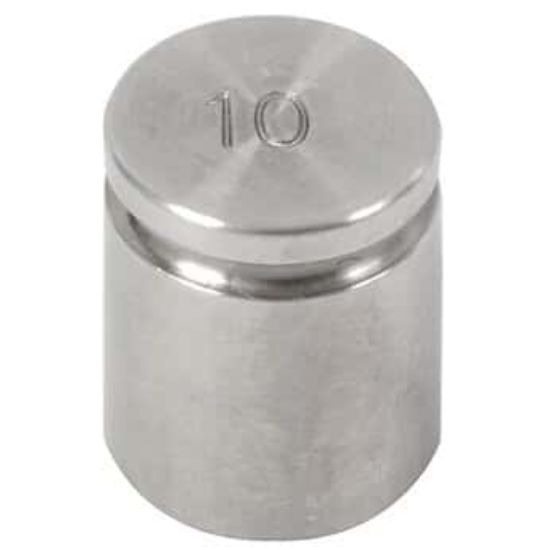
What A Traceable Reference Standard Looks Like
A Troemner Class F test weight with a traceable certificate is the kind of reference standard an accredited balance calibration is checked against. The certificate that comes with it, not just the weight itself, is what carries the traceability back through the measurement chain.
Common Mistakes And Misconceptions
Most Common Mistake
Assuming any mention of "accredited" on a NZ supplier's page means IANZ accredited. Some suppliers reference NATA (the Australian equivalent) on New Zealand-facing pages, sometimes because the calibration work is actually subcontracted to an Australian-accredited facility, and sometimes simply because AU-written copy was reused on the NZ site without updating it. Either way, always ask the supplier directly which body accredited the specific certificate you were issued, and check the certificate itself rather than the marketing page.
- Treating "ISO 17025 compliant" as the same as "IANZ accredited": A lab can say its methods follow ISO/IEC 17025 without ever having been independently assessed and accredited against it. Compliance is a claim; accreditation is a verified status.
- Ignoring the scope: Accreditation applies to specific measurements and ranges, not a business as a whole. Always confirm the exact scope covers the equipment being calibrated.
- Assuming accreditation never expires or changes: Accreditation is reassessed periodically. A supplier accredited two years ago may have changed scope, suspended a specific method, or let accreditation lapse since then.
Related NZ Services
Pipette Calibration Services · Calibration And Repair Solutions · Installation Services
Frequently Asked Questions
What does IANZ stand for?
IANZ stands for International Accreditation New Zealand. It is New Zealand's national accreditation body for testing, calibration, inspection and certification organisations, operating as a business unit of Toitu te Waiora.
Is IANZ the same as NATA?
No. IANZ is New Zealand's accreditation body and NATA (National Association of Testing Authorities) is Australia's. Both assess laboratories against the same underlying international standard, ISO/IEC 17025, and both are recognised through the same international mutual recognition framework, but they are separate organisations issuing separate certificates. For the equivalent guide covering the Australian side, see John Morris Group's NATA pipette calibration services guide.
Does IANZ accreditation ever expire?
Accreditation is maintained through periodic reassessment rather than being granted once and left indefinitely. A laboratory's scope of accreditation can also change between assessments, so a certificate issued some years ago is not automatic proof of current accreditation status.
What is ISO/IEC 17025?
ISO/IEC 17025 is the international standard for the competence of testing and calibration laboratories. It covers both the management system a lab runs and the technical competence of its staff, equipment and methods. IANZ uses this standard to assess NZ laboratories before granting accreditation.
What is a traceable calibration certificate?
A traceable calibration certificate documents an unbroken chain of comparisons linking a measurement result back to a recognised national or international standard, with each step in the chain carrying a stated uncertainty. It is what lets two different labs' results be meaningfully compared.
How do I find out if a specific lab is IANZ accredited?
IANZ accreditation is a matter of public record for accredited facilities. Ask your supplier directly for their accreditation number and scope, and confirm it covers the specific measurement or calibration you need, rather than relying on general marketing language about being "accredited."
Why does my calibration certificate mention NATA instead of IANZ?
This usually means the calibration was actually performed by, or under, an Australian-accredited facility rather than a New Zealand IANZ-accredited one. That is not automatically a problem, since NATA and IANZ certificates are generally treated as equivalent under international mutual recognition arrangements, but you should confirm with your supplier which body actually issued the certificate and whether that matters for your specific compliance requirements.
Need Calibration Services For Your NZ Laboratory?
John Morris Group provides pipette, balance and instrument calibration and repair services across New Zealand. Ask your provider about accreditation status and scope before booking any calibration work.
Call 0800 651 700 or see our pipette calibration services page.