A Nederman(Kinesis) fume extractor arm is a flexible, articulated extraction unit that captures airborne fumes, smoke, dust, and particles directly at the source. It connects to a fan unit and uses friction joints with a 360 degree swivel base to hold any position without drifting. Nederman(Kinesis) extractor arms are used in Australian laboratories for chemical handling, soldering, sample digestion, dust capture, and 3D printing fume extraction.
Fume extraction is not optional in laboratories where chemical vapours, soldering smoke, or particulate dust are generated. Poor air quality affects both operator health and experimental accuracy. This guide covers the Nederman(Kinesis) models available through John Morris Group, how to choose the right arm length, and when an extractor arm is the right choice compared to other laboratory fume extraction options.
In This Guide
How They Work · Models Available · Laboratory Applications · How to Choose · Extractor Arm vs Fume Hood · Common Mistakes · FAQ
What Is a Fume Extractor Arm?
A fume extractor arm is a flexible, articulated extraction unit that captures airborne contaminants directly at the source. It connects to an extraction fan or centralised ventilation system and can be repositioned to follow the work as it moves across a bench or workstation. Unlike a fume hood, it is open (not enclosed) and provides localised source capture rather than full containment.
How Nederman(Kinesis) Fume Extractor Arms Work
Nederman(Kinesis) fume extractor arms use specially designed friction joints that allow the hood to be positioned at any point within the working area and hold that position without drifting. A 360 degree swivel elbow at the base provides unlimited manoeuvrability, so the arm can follow the operator around the workspace.
The arm connects to a fan unit that generates airflow up to 650 CFM (1,100 m³/h), drawing fumes, smoke, dust, and particles into the hood and away from the breathing zone. This source-capture approach is more effective than relying on general room ventilation because it removes contaminants before they disperse into the wider laboratory environment.
The maximum operating temperature for Nederman(Kinesis) extractor arms is 70 degrees Celsius (158 degrees Fahrenheit), making them suitable for standard laboratory processes but not for direct contact with open flames or extremely hot exhaust.
Nederman(Kinesis) Fume Extractor Arms Available at John Morris Group
| Model | Arm Length | Best For | Key Feature |
|---|---|---|---|
| 7 ft (2.1 m) Extractor Arm | 7 ft / 2.1 m (84") | Small workstations, benchtop extraction | Compact reach for tight lab spaces |
| 10 ft (3.0 m) Extractor Arm | 10 ft / 3.0 m | Medium work areas | Balance of reach and control |
| 14 ft (4.3 m) Extractor Arm with Light | 14 ft / 4.3 m (168") | Wide work areas, fume hoods with limited reach | Integrated workspace light for visibility |
| Telescopic Extractor Arm | 34" to 5 ft (0.9 to 1.5 m) | Compact labs, space-limited installations | Retracts when not in use to save space |
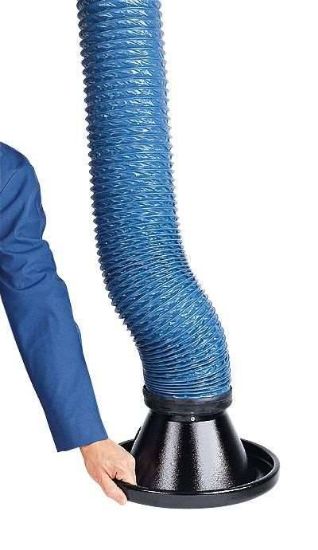
All models include a 250 x 300 mm (10" x 12") oval polycarbonate hood with handle and damper, and 160 mm (6-1/4") OD PVC fibreglass-reinforced hose. The telescopic model includes a round hood with damper instead. Each arm requires a compatible fan unit, available separately as 3/4 hp or 1 hp configurations.
Browse the full Nederman(Kinesis) fume extractor range at John Morris Group or call 1300 501 555 for a recommendation.
Laboratory Applications for Fume Extractor Arms
While Nederman(Kinesis) is widely known for welding fume extraction in industrial settings, their extractor arms are equally effective in laboratory environments where localised fume capture is needed:
- Chemical handling and reagent preparation: Capturing vapours from volatile solvents, acids, or bases during sample preparation, particularly when work is done outside a traditional fume hood.
- Soldering and electronics assembly: Removing solder fumes and flux vapours that contain harmful particulates. Common in electronics labs, prototyping facilities, and university engineering departments.
- Sample digestion and acid work: Extracting fumes during microwave digestion, Kjeldahl distillation, or other heated acid procedures where localised vapour capture at the bench is needed.
- Dust and particulate capture: Removing airborne dust during weighing, grinding, or material preparation work near precision balances or sample processing stations. Proper fume extraction helps maintain the accuracy of sensitive instruments like viscometers and analytical balances that are affected by airborne contamination.
- 3D printing and laser cutting labs: Capturing fumes and ultrafine particles generated during additive manufacturing and material processing.
How to Choose the Right Fume Extractor Arm
1. Measure your workspace reach. The arm must reach from its mounting point to the furthest point where fumes are generated. The 7 ft (2.1 m) and telescopic models suit benchtop and compact spaces. The 10 ft (3.0 m) and 14 ft (4.3 m) models cover wider areas where the source moves during work.
2. Consider mounting options. Nederman(Kinesis) arms mount via a wall bracket or bench clamp connected to the swivel elbow. Confirm you have a suitable mounting point that allows the full range of arm movement without obstruction.
3. Match the fan to the application. The 3/4 hp fan suits lighter extraction duties. The 1 hp fan is recommended for longer arm lengths, higher particle loads, or ducting runs where additional static pressure is needed.
4. Decide whether you need integrated lighting. The 14 ft (4.3 m) model includes a built-in light that illuminates the work area. This is particularly useful in laboratories with overhead lighting that creates shadows on the bench.
5. Check temperature limits. Nederman(Kinesis) extractor arms are rated to a maximum operating temperature of 70 degrees Celsius. If your process generates higher temperatures, you may need a specialised high-temperature extraction solution.
Fume Extractor Arm vs Fume Hood: Which Do You Need?
| Factor | Fume Extractor Arm | Ducted Fume Hood | Ductless Fume Hood |
|---|---|---|---|
| Best for | Flexible, mobile source capture at the bench | Contained work with toxic or volatile chemicals | Filtered recirculation where ducting is not possible |
| Installation | Wall or bench mount, simple setup | Permanent, requires building ducting | Plug-and-play, no external ducting |
| Flexibility | Repositions to follow the work | Fixed position | Fixed position (some portable models) |
| Containment level | Open capture (no enclosure) | Full enclosure with sash | Partial enclosure with filtered air return |
| Australian brands at JMG | Nederman(Kinesis) (via Kinesis) | Ducted fume hood | Ductless fume hood |
When to choose a fume extractor arm: When the fume source moves across the bench, when you need extraction at multiple points in the same room, or when installing a full fume hood is not practical due to space or budget constraints. Extractor arms complement fume hoods rather than replacing them. Many Australian labs use both: a ducted fume hood for concentrated chemical work and extractor arms at satellite workstations for lighter extraction duties.
Common Mistakes When Selecting a Fume Extractor
Most Common Mistake
Choosing an arm that is too short for the workspace. If the hood cannot reach the fume source, extraction effectiveness drops dramatically. Always measure the maximum distance from the mounting point to the furthest work position before ordering. It is better to have a slightly longer arm than one that cannot reach.
- Undersized fan: A fan that is too small for the arm length or ducting run will not generate enough airflow to capture fumes effectively. For longer arms or runs with bends, the 1 hp fan is the safer choice.
- Positioning the hood too far from the source: Capture efficiency drops rapidly with distance. The hood should be positioned as close to the fume source as practical, ideally within 30 cm for light vapours.
- Using an extractor arm where a fume hood is required: Extractor arms are not enclosed. For work with highly toxic, volatile, or carcinogenic chemicals, a ducted fume hood or ductless filtered hood provides the containment level required by AS/NZS 2243.
- Forgetting to check mounting clearance: The arm needs full 360 degree rotation from its mount point. If shelving, ducting, or equipment blocks the swing path, the arm cannot reach all areas of the bench effectively.
Related Guides
What Is Viscosity? · How to Clean Lab Glassware · What Is Borosilicate Glass?
Frequently Asked Questions
What is a Nederman(Kinesis) fume extractor?
Nederman(Kinesis) fume extractors are articulated extraction arms that capture airborne fumes, smoke, dust, and particles directly at the source. They connect to a fan unit and can be repositioned around the workspace using friction joints and a 360 degree swivel base. They are widely used in laboratories, welding environments, and industrial manufacturing.
What arm length do I need?
The 7 ft (2.1 m) arm and telescopic model suit small workstations and benchtop extraction. The 10 ft (3.0 m) arm covers medium work areas. The 14 ft (4.3 m) arm is best for wide work areas or situations where the operator moves across a larger bench. Always measure from the mounting point to the furthest fume source before ordering.
How much does a Nederman(Kinesis) fume extractor cost in Australia?
Pricing depends on the arm length, fan specification, and any accessories required. Contact John Morris Group on 1300 501 555 for current pricing on Nederman(Kinesis) fume extractor arms and fan units. We supply all arm lengths and configurations with delivery across Australia and New Zealand.
Can I use a fume extractor arm instead of a fume hood?
Fume extractor arms are excellent for localised source capture of light to moderate fumes, but they are not enclosed. For work with highly toxic or volatile chemicals, a ducted fume hood or ductless filtered hood provides the containment level required by Australian laboratory safety standards.
Do Nederman(Kinesis) fume extractor arms come with a fan?
No. The arm and fan are sold separately, which allows you to match the fan power to your specific extraction requirements. The 3/4 hp fan suits lighter duties and shorter arms. The 1 hp fan is recommended for longer arms, higher particle loads, or ducting runs with bends.
What is the maximum temperature for a Nederman(Kinesis) extractor arm?
Nederman(Kinesis) extractor arms are rated to a maximum operating temperature of 70 degrees Celsius (158 degrees Fahrenheit). They are suitable for standard laboratory fume extraction but should not be used in direct contact with open flames or extremely hot exhaust.
Where can I buy Nederman(Kinesis) fume extractors in Australia?
John Morris Group supplies Nederman(Kinesis) fume extractor arms through Kinesis with local technical guidance, installation support, and ongoing service across Australia and New Zealand. Call 1300 501 555 or browse our laboratory and scientific equipment online.
Need Help Choosing a Fume Extraction Solution?
Whether you need a Nederman(Kinesis) extractor arm for benchtop fume capture, a telescopic arm for compact spaces, or a complete system with fan unit for a new laboratory installation, our team can help you select the right configuration.
Call 1300 501 555 or browse our Nederman(Kinesis) fume extractor range online.