Laboratory Filter Paper Grades: Pore Size, Speed And Applications
Filter paper grade determines what a filtration actually separates and how fast it happens, not just whether the paper "works."
Choosing between a qualitative grade for routine clarification and a quantitative ashless grade for gravimetric analysis comes down to matching pore size and flow rate to what the result is actually used for.
What Do Filter Paper Grades Mean?
A filter paper grade sets its particle retention (the smallest particle size it reliably captures) and its flow rate (how quickly liquid passes through). Coarser grades retain larger particles and filter fast; finer grades retain smaller particles but filter more slowly, since a tighter pore structure resists flow.
Grades also split into two families by purpose: qualitative papers for routine clarification and sample preparation, and quantitative (usually ashless) papers for gravimetric analysis, where the paper itself must leave almost no residue behind after combustion.
What Is Laboratory Filter Paper?
Laboratory filter paper is a porous cellulose (or, for high-purity work, glass microfibre) medium used to separate solids from liquids by gravity or vacuum filtration. Unlike a general-purpose coffee or air filter, laboratory grades are manufactured to a controlled, repeatable pore structure so the same grade behaves consistently between batches and between suppliers.
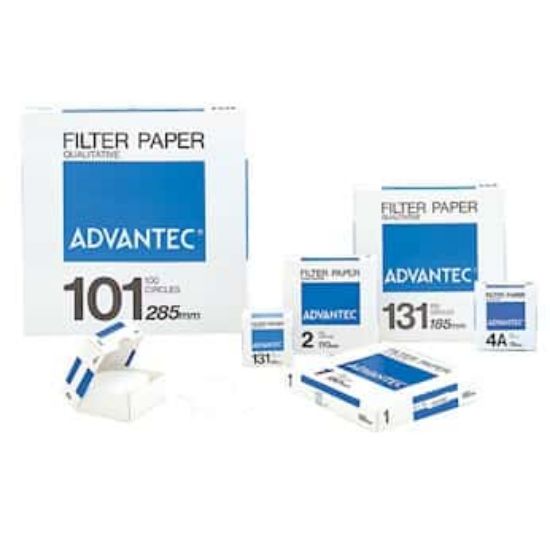
Grades are typically identified either by a manufacturer's numbered system (Advantec's No. 1, No. 2, 4A and 5B, or Whatman's equivalent numbered range) or by a descriptive tier such as coarse, medium, fine or very fine. The numbers matter more than they first appear: a No. 1 and a No. 2 grade from the same manufacturer can have meaningfully different retention and speed despite looking identical out of the box.
Filter paper is frequently used alongside other laboratory glassware in the same workflow. See our guide to graduated cylinders for measuring the filtrate once filtration is complete.
Common Filter Paper Applications
- •Clarifying solutions and removing precipitates before analysis
- •Gravimetric analysis, where the residue itself is weighed
- •Environmental and water testing (suspended solids, soil analysis)
- •Food and beverage quality control (sediment, milk fat testing)
- •General sample preparation ahead of instrumental analysis
Qualitative Or Quantitative, Which Do You Need?
Start with whether the paper itself needs to disappear from the result (quantitative work) or is just doing a clarification job (qualitative work), then confirm pore size and speed.
Choose Qualitative If
- •You're clarifying a solution or removing precipitate before analysis
- •The paper itself won't be weighed or ashed as part of the result
- •You're preparing routine samples for instrumental analysis
- •Cost per sheet matters more than ultra-low ash content
Choose Quantitative (Ashless) If
- •You're running gravimetric analysis and need to weigh the residue
- •The paper needs to be ashed or incinerated as part of the method
- •Trace metal or environmental analysis requires minimal contamination
- •You need a documented, low, known ash content
Ask Before Buying
- •What particle size does the precipitate or sediment actually need to be retained at?
- •Does the method specify a particular grade, or just "filter paper"?
- •Will filtration run by gravity or under vacuum, and does speed matter?
- •Do you need flat circles, pre-folded papers, or a specific diameter for your funnel?
Qualitative Vs Quantitative Filter Paper At A Glance
If you want a quick answer, this table shows where each family is usually the better choice.
| Criteria | Qualitative Filter Paper | Quantitative (Ashless) Filter Paper | Better Choice |
|---|---|---|---|
| Ash Content | Not controlled to a documented low value | ✓ Typically around 0.01% or lower | Quantitative |
| Typical Use | ✓ Clarification, routine sample prep | Gravimetric analysis, trace/environmental work | Depends On Application |
| Typical Cost Per Sheet | ✓ Generally lower | Generally higher, reflecting the acid-washing process | Qualitative |
| Available Grades | ✓ Wide range, coarse through fine | Narrower range, usually medium to fine retention | Qualitative |
| Suitable For Weighing/Ashing | Not recommended; ash content isn't documented | ✓ Purpose-built for this | Quantitative |
Filter Paper Grades By Pore Size And Retention
Coarse retention (roughly 8 to 25 microns): fast-flowing grades built for large crystalline precipitates, sand and coarse soil particles. Advantec's Grade No. 1 sits in this tier, prioritising speed over holding back fine particulate.
Medium retention (roughly 5 to 8 microns): the general-purpose tier most laboratories reach for by default, balancing a fast flow rate with retention fine enough for routine clarification. Advantec's Grade No. 2 is a typical medium-retention, fast-flow grade.
Fine retention (roughly 2 to 5 microns): slower-flowing grades for finer precipitates, protein work and samples that would pass straight through a coarser paper.
Ashless quantitative grades: acid-washed papers, such as Advantec's Grade 5B or Hahnemühle's 589 series, engineered for a documented low ash content rather than a specific pore-size tier alone, so the residue can be weighed accurately after combustion.
Why Choosing The Right Grade Matters
1. Accurate Gravimetric Results
Using an ashless grade where the method calls for one keeps residual paper mass out of the final weighed result.
2. Faster Routine Filtration
Matching pore size to the sample rather than defaulting to the finest paper available avoids unnecessarily slow filtration on routine work.
3. Fewer Clogged Or Torn Filters
A grade that's too fine for a heavily particulate sample clogs and slows dramatically; one that's too coarse lets fine material straight through.
4. Method And Standard Compliance
Many standard methods (ASTM, AOAC, environmental testing protocols) specify a particular grade by name, not just "filter paper."
5. Consistent Batch-To-Batch Results
A controlled manufacturing process means the same grade behaves the same way across packs, batches and reorders.
6. Low Cost Relative To The Result It Protects
Filter paper is a small line item compared with the sample, instrument time or compliance outcome riding on the filtration step.
What Does Filtration Speed Mean On A Spec Sheet?
Flow rate (often listed as fast, medium-fast or slow) describes how quickly liquid passes through the paper under gravity, and it's driven almost entirely by pore structure rather than paper thickness. A coarse, open pore structure lets liquid through quickly at the cost of retaining only larger particles; a tighter, fine pore structure retains more but resists flow more, so filtration takes longer.
Format affects speed too. Pre-folded (fluted) papers, like Macherey-Nagel's MN 615 ¼ range, expose more surface area to the funnel than a flat circle folded by hand, which is why they're commonly listed as medium-fast even at a similar retention grade to a flat equivalent.
Vacuum filtration speeds up any grade by adding pressure differential across the paper, but it doesn't change what the paper retains: a fine-retention grade under vacuum still holds back the same particle size, it just does so faster than under gravity alone.
Filter Paper At John Morris Group
A cross-section of Advantec, Macherey-Nagel and Hahnemühle grades covering coarse through fine qualitative retention and ashless quantitative options. Pricing shown is indicative only; confirm current pricing on each product page.
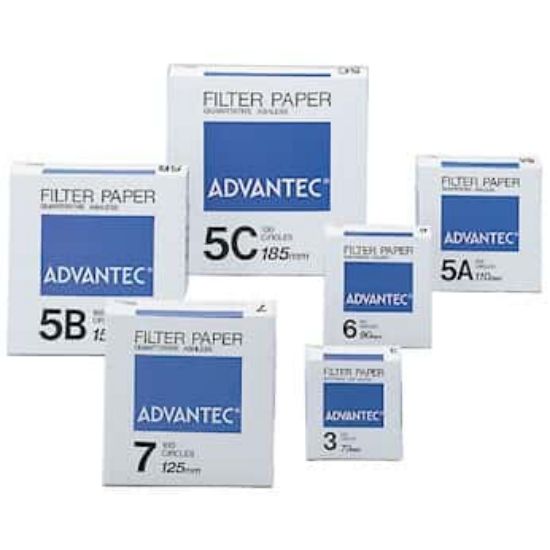
Advantec Grade 5B Ashless Quantitative Filter Paper, 7.0cm
Double acid-washed alpha cellulose with medium retention (5 to 10 microns) and low, documented ash content, built for gravimetric analysis and environmental monitoring rather than routine clarification. Mid-range pricing; see the product page for current pricing.
Browse This Filter Paper
Advantec Grade No. 2 Qualitative Filter Paper, 18.5cm
Medium retention with a fast flow rate, rated to 120°C and a 0 to 12 pH range, making it a practical default for clarifying solutions and general qualitative analysis. Entry-level pricing; see the product page for current pricing.
Browse This Filter Paper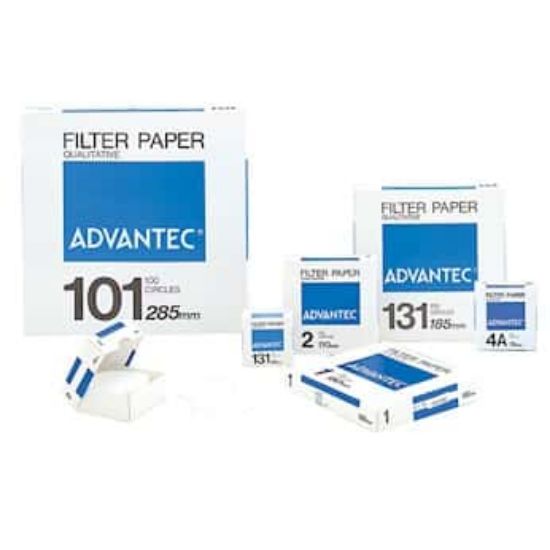
Advantec Grade No. 1 Qualitative Filter Paper, 11.0cm
Coarse retention for large crystalline and gelatinous precipitates, prioritising flow rate over fine particle capture. A sensible choice ahead of an instrument that doesn't need especially clean filtrate. Entry-level pricing; see the product page for current pricing.
Browse This Filter Paper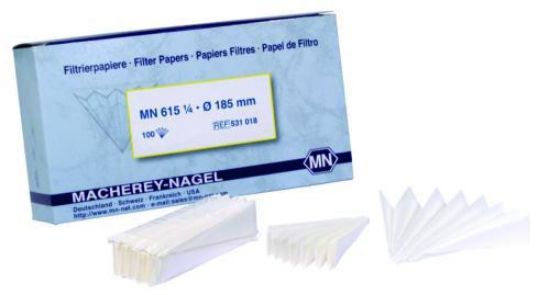
Macherey-Nagel Filter Papers Folded, MN 615 ¼, 185mm
Pre-folded qualitative papers with a medium-fast flow rate, saving a manual folding step and giving a more consistent filtration surface than hand-folded flat circles. Entry-level pricing; see the product page for current pricing.
Browse This Filter Paper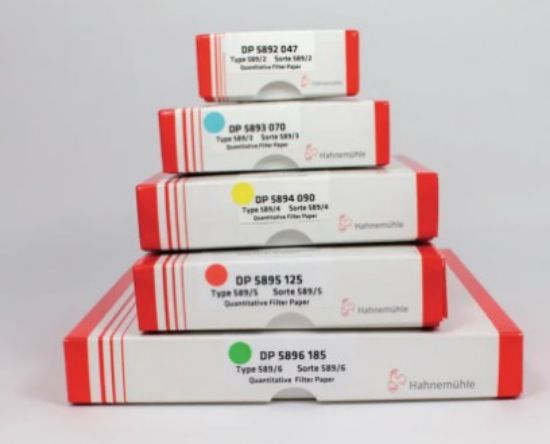
Hahnemühle Filter Circles 589/5, 90mm, Quantitative
Acid-washed, mineral and metallic-ion-free ashless paper at approximately 0.004% ash content, a strong fit for trace-metal or high-purity gravimetric work where even a low-ash grade like 5B isn't quite clean enough. Mid-range pricing; see the product page for current pricing.
Browse This Filter PaperExplore More Laboratory Basics
Filter paper is one of several everyday laboratory basics worth getting right. See how these related guides connect.
What Is A Burette?
See how burettes handle precise volume delivery in titration, another everyday laboratory technique alongside filtration.
Read The Burette GuideBorosilicate Vs Soda-Lime Glass
Compare the glassware filter paper is typically used with, and which glass type suits repeated laboratory use.
Read The Glassware GuideWhat Is A Graduated Cylinder?
Learn how to measure filtrate volume accurately once filtration is complete.
Read The Graduated Cylinder GuideFilter Paper FAQs
What Is The Difference Between Qualitative And Quantitative Filter Paper?
Qualitative filter paper is used for routine clarification and sample preparation where the paper itself isn't part of the result. Quantitative, usually ashless, filter paper is acid-washed to a documented low ash content so it can be weighed or incinerated as part of a gravimetric method without contaminating the result.
What Do Filter Paper Grade Numbers Mean?
Manufacturers assign each grade number a specific particle retention and flow rate combination. A lower number doesn't automatically mean coarser or finer across every brand; always check the specific retention and speed listed for that grade rather than assuming numbers are directly comparable between manufacturers.
What Is Ashless Filter Paper Used For?
Ashless filter paper is used in gravimetric analysis, where the collected precipitate is incinerated and weighed. Because the paper itself leaves almost no residue behind after combustion (commonly around 0.01% ash or lower), the final weight reflects the sample, not the filter.
How Do I Choose The Right Pore Size?
Match the grade to the smallest particle you actually need to retain: coarse for large crystalline precipitates and sand, medium for general clarification, and fine for smaller precipitates or protein work. If a standard method specifies a grade, use that grade rather than substituting a similar-looking one.
What Does Filtration Speed Mean On A Filter Paper Spec Sheet?
Filtration speed (fast, medium-fast or slow) describes how quickly liquid passes through the paper under gravity. It's driven by pore structure: coarser, more open grades filter faster but retain less; finer grades retain more but filter more slowly.
Can Filter Paper Be Folded For Faster Filtration?
Yes. A fluted or concertina fold exposes more paper surface area to the funnel than a simple quarter-fold, increasing flow rate for the same grade. Pre-folded papers achieve this consistently without a manual folding step.
What Is The Maximum Temperature Filter Paper Can Withstand?
Standard cellulose filter papers are typically rated to around 120°C, well above the temperature of most gravity or vacuum filtration work. For genuinely high-temperature filtration, glass microfibre filters are the appropriate alternative rather than pushing cellulose paper beyond its rated limit.
How Should Filter Paper Be Stored?
Keep filter paper in its original packaging, in a dry, dust-free environment away from direct sunlight and chemical fumes. Ashless and quantitative grades in particular should be handled with clean, dry hands or forceps to avoid introducing contamination before use.
Need Help Choosing The Right Filter Paper Grade?
Talk to John Morris Group about qualitative and ashless quantitative filter paper for laboratory, environmental and food and beverage testing applications.
Contact UsCall 1300 501 555 or contact John Morris Group for quotation and technical support.