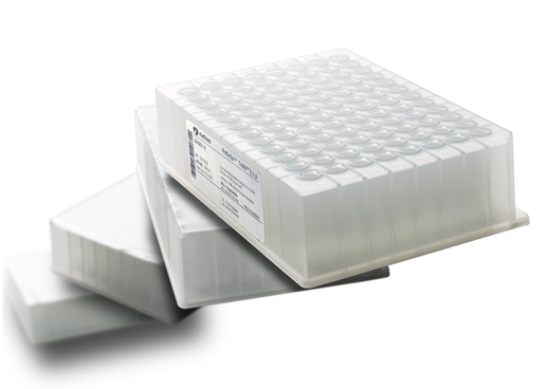
The PreDictor MabSelect SuRe 50 µL 96-well Plates, Pack of 4 (28925825) are disposable 96-well filter plates prefilled with MabSelect SuRe affinity resin for high-throughput process development. Each well contains 50 µL of sedimented resin and has an 800 µL total well volume, supporting parallel screening of monoclonal antibody capture conditions.
Key Features
- Single-resin MabSelect SuRe format, supplied for protein A affinity screening using MabSelect SuRe resin
- Higher 50 µL resin volume per well, suitable for experiments where protein concentrations are higher or where more sample is needed for analysis
- Disposable 96-well plate design, made from polypropylene and polyethylene
- Defined working range, supporting 100 to 300 µL working volume per well when incubating on a microplate shaker
- Alkali-tolerant protein A-derived ligand, allowing use of 0.1 to 0.5 M sodium hydroxide for cleaning-in-place
- MabSelect SuRe resin characteristics, using a highly cross-linked spherical agarose matrix with an approximately 85 µm particle size
- Protein A capture performance, with dynamic binding capacity of approximately 35 mg hIgG/mL resin under Cytiva stated test conditions
Benefits
- Supports rapid parallel screening of binding, wash, and elution conditions for monoclonal antibody capture workflows.
- Provides a larger resin volume option for studies that need more recovered sample for downstream analysis.
- Allows manual operation with multichannel pipettes or automated operation with robotic systems.
- Provides four plates in one pack, supporting repeat testing and study planning across multiple conditions.
Why Choose the PreDictor MabSelect SuRe 50 µL 96-well Plates, Pack of 4 (28925825)?
The PreDictor MabSelect SuRe 50 µL 96-well Plates, Pack of 4 (28925825) provide a practical high-throughput format for evaluating MabSelect SuRe protein A affinity capture conditions before moving to column optimisation. John Morris Group supplies Cytiva chromatography consumables to support reliable process development workflows across Australian laboratories.