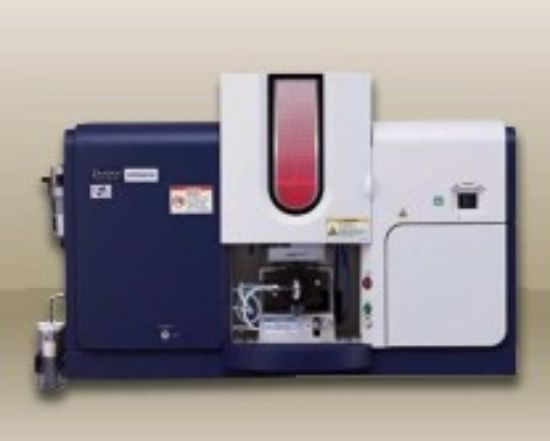
Hitachi offers high-precision background correction and high-sensitivity measurement by employing the polarized Zeeman correction method alongside the dual detector method.
Atomic absorption spectrophotometers typically atomize elements via one of two methods depending on the concentration to be measured: the flame method, in which elements are atomized by a chemical flame, or the graphite method, in which elements are atomized in an electric furnace.
They exploit the fact that atomized elements absorb light at specific characteristic wavelengths; to determine the concentration of a given element in an unknown sample, the sample's light absorption (or absorbance) is measured, and the absorbance values are converted to concentration values using calibration curves, rules relating absorbance to concentration that are prepared using standard solutions with known concentrations.
If other substances are also present in the sample, they will absorb light at specific wavelengths that are known to produce errors in measured values; this is known as background. To mitigate the impact of the background, Hitachi's atomic absorption spectrophotometers implement the method of polarized Zeeman correction using permanent magnets to obtain highly accurate measured values. This is done by providing a stabilised baseline, surpressing the effects of coexisting materials that have absorption of adjacent wavelengths, and facilitates highly reliable analysis.
The dual detector method used increases the amount of sampled light and reduces the effect of baseline noise. The two lights are also detected simultaneously which increases the accuray of corrections.
All elements are cpovered by the polarised Zeeman correction method. Background correction can be performed for elements that have absorption in the ultraviolet or visible ranges.It has the advantage that it does not need to be selected for each element and it can also correct elements that cannot be corrected by the D2 lamp correction method, such as sodium and potassium.
- Providing High Precision Analysis even for high-matrix samples - with the polarised Zeeman correction method, measurement is possible even if the background absorption exists at nearby wavelengths.
- High Sensitivity Analysis - the stable baseline provided and thus low concentration analysis can be performed with high sensity measurement without using any additional accessories.
- Supporting Measurement of Organic Solvents - Even for solutions based on organic solvents, the polarised Zeeman correction method is able to provide a stable baseline.
- Auto-Start and Voice Guidance - Drift is surpressed by the polarised Zeeman correction method and the absorbance returns to near zero during blank absorption. Because of this, measurement can be performed by automatically determining the timings of sample injection, measurement start and measurement end.The timing for switching out samples is notified by voice guidance.
- Increased Usability - The front panel is equipped with "Start Measurement" and "Auto-Zero" buttons making it possible to perform a series of measurements without using a computer.
- Emission Background Correction Function - background intensity is measured near the measurement wavelength and the background is corrected using the base emission intensity for each sample.
- Environmentally Friendly - achieved with water saving and power saving modes.
- Safety Functions - There are many different safety functions included, increasing safety for the operator.
NOTE: Needed to supply locally: PC, UPS, Gas, Standard solutions